An original narrative world · In development
EIDARA
A world shaped by distance, memory, obligation, and the consequences of what people believe.
The current story is encountered through Orvain, a forest-dominant region where settlements survive by maintaining what the land, distance, and one another put under pressure.
Enter Orvain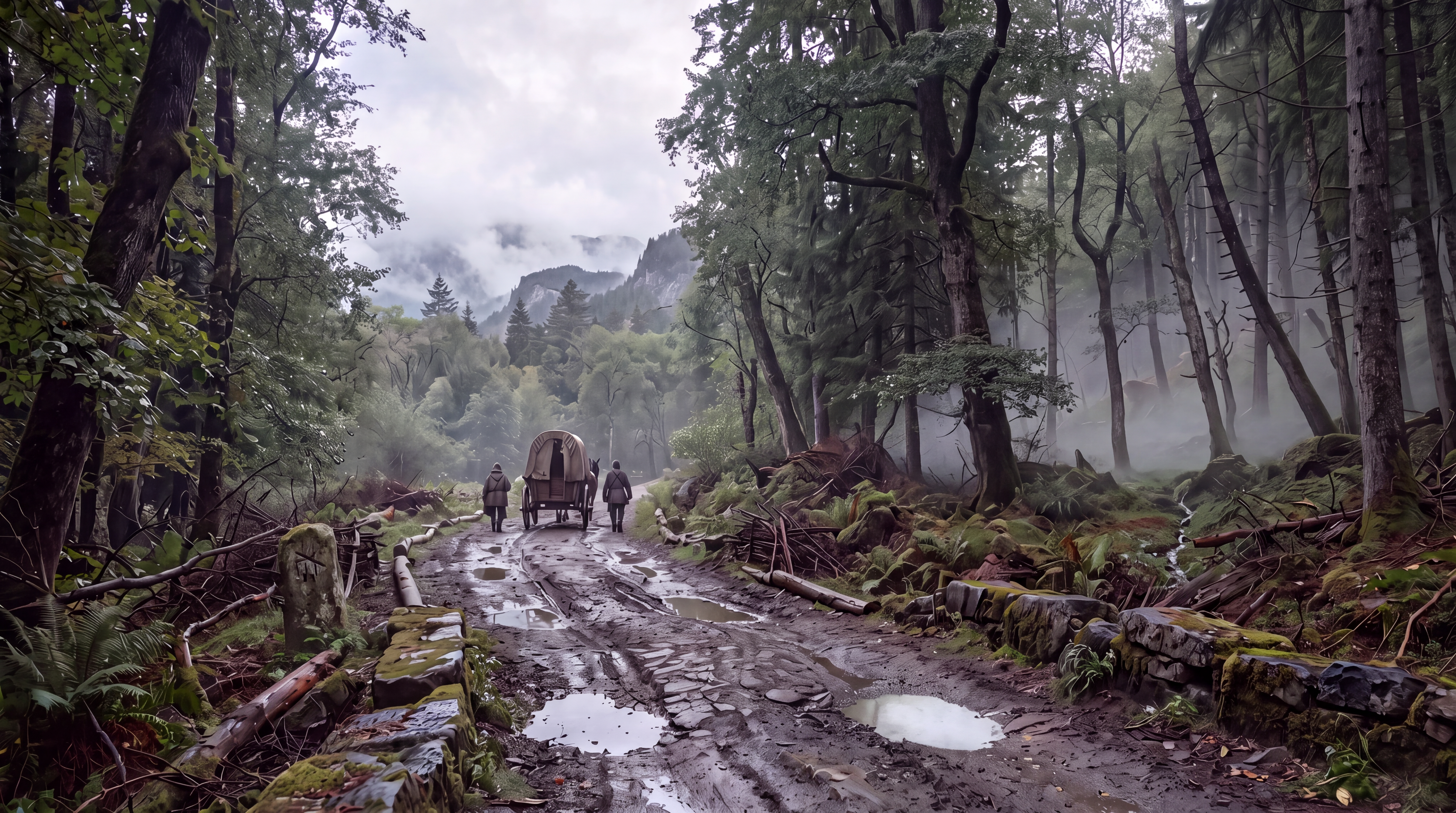
The current lens / Orvain
Maintained,
not controlled.
Eidara is the world. Orvain is one continental region within it.
Across much of Orvain, forest is the default. Settlements are maintained pockets of stability. Terrain limits movement; a road changes with its use and upkeep.
Institutions have reach, but that reach depends on people, supplies, and news making it through. A short distance can still be a difficult journey.
What keeps a place standing
A world that requires maintenance.
Nothing recurring exists without support.
Food and water. Shelter and storage. Tools, repair, and the hands to do the work. A settlement needs protection, routes, and a continuing supply of materials.
A road stays usable because people need it, use it, watch it, and repair it. A patrol takes people, food, equipment, time, and attention away from somewhere else. An institution depends on the same material world as the people it serves.
Between places
Distance has consequences.
Travel in Orvain is defined less by distance than by how long the world continues to behave predictably.
Maintained
Use, watch, and repair keep a route dependable within local reach.
Degraded
Beyond regular upkeep, weather and wear make passage less certain.
Broken
Continuity can no longer be assumed. The way forward has to be reassessed.
Maintained → degraded → broken describes declining route reliability, not a fixed sequence on every journey. Safety is local, not continuous.
Most movement is on foot or in small groups. What can be carried matters. Animals add capacity and cost; a wagon is uncommon, and its passage asks more of a road.
Weather, terrain, and route condition change the journey. Trade and messengers face the same constraints. A message cannot arrive more easily than the person carrying it.
People / A few encounters
A world lived
one person at a time.
Terrain, obligation, and incomplete knowledge press differently on each life.
Attention
Locke Ashmere
Quiet, adaptive, and shaped by the field. Locke reads terrain and movement, the mismatch in a pattern, the silence where something should be. What he notices matters to what happens next.
Protection
Kealira Selven
Grounded and disciplined, Kealira meets pressure through action. Her shield comes forward; protection is something she does, with the responsibility that follows.
Self-law
Vannya
An independent operator guided by her own law. Local knowledge and survival shape her choices; control over an outcome matters more than the reassurance of formal authority.
Places / Within Orvain
Places that hold differently.
The same need for stability. Different ground beneath it.
Coast / Fort-town
Ridgewatch
A small coastal fort-town with little redundancy. The work that keeps it standing remains visible, and people know one another through contribution and reliability.
Elevated coast / Collegium
Highreach
An elevated coastal settlement shaped strongly by the Collegium. Observation, records, and classification share space with craft, labor, faith, and ordinary life under institutional pressure.
Inland / Marsh
Dreth Hollow
A low inland marsh settlement where authority is fragmented and stability is negotiated. Terrain, scarcity, strained infrastructure, faction relationships, and human choices make order difficult to hold.
Belief / Knowledge
People do not know
the same world.
No person or institution possesses complete objective knowledge. What someone knows depends on where they stand, what reaches them, and how they understand it.
The Collegium
Observation, records, comparison, and classification give the Collegium disciplined models to work with. Those models are useful. They remain incomplete.
The Temple
Faith, preservation, right practice, and doctrine offer ways to approach uncertainty. They do not give the Temple complete knowledge of the world.
Local knowledge
A practical warning can be accurate without a formal explanation. A traveler may know a road is wrong long before an institution can explain why.
News travels with traders, patrols, messengers, letters, and oral retelling. Distance, weather, danger, authority, memory, and politics can change what arrives.
Consequence / Memory
The world does not reset
between scenes.
An abandoned structure. A route no longer used. Missing labor, damaged trust, a warning passed on. Places carry what has happened through records, stories, names, and daily practice.
People carry it too: injury and fatigue, grief and relationships, misunderstanding and learned skill. Growth is earned, and what has been learned is never everything.
The Origins of Eidara
James Capps first conceived Eidara in 1994 and continued developing its world and characters over the following three decades. Long before the manuscript began, its characters were already established in his imagination.
In October 2025, he began bringing that longstanding story into written form, starting work on the first Eidara book.
Fragments of Eidara
Before Dark
A scene with Kealira and Locke.
“I’m not staying here,” she said.
“I know.”
Beyond this threshold
Explore deeper.
Orvain is where the current story is grounded. It is not the full extent of Eidara.
This is a first doorway. Further encounters and records are still in development.
Future directions / Not yet open
- People
- Places & settlements
- Regions & geography
- Routes & travel
- Institutions & groups
- Energy & phenomena
- Belief & knowledge
- Material life & trade
- History & memory
- Language & terminology